Common TOEIC answer traps

TOEIC wrong options are designed to catch you with the same few tricks: words that sound like the audio, options that repeat words you heard, statements that are true but don't answer the question, and word forms that look right but break the grammar. The correct answer is usually a paraphrase, so learn to choose meaning over matching words.
Listening traps (Parts 1–4)
- Similar sounds: you hear "copy" and an option says "coffee", or "walk" and "work".
- Repeated words: in Part 2 the option that repeats a word from the question is often wrong.
- Yes/No to a Wh- question: "Where is the meeting?" cannot be answered with "Yes, it is."
- Right object, wrong action: in Part 1 the photo shows a laptop, but no one is "typing" on it.
Reading traps (Parts 5–7)
- Word form: four options from the same root (decide, decision, decisive, decisively). Check the grammar slot before the meaning.
- Plausible but wrong grammar: an option that makes sense but does not fit the tense or subject.
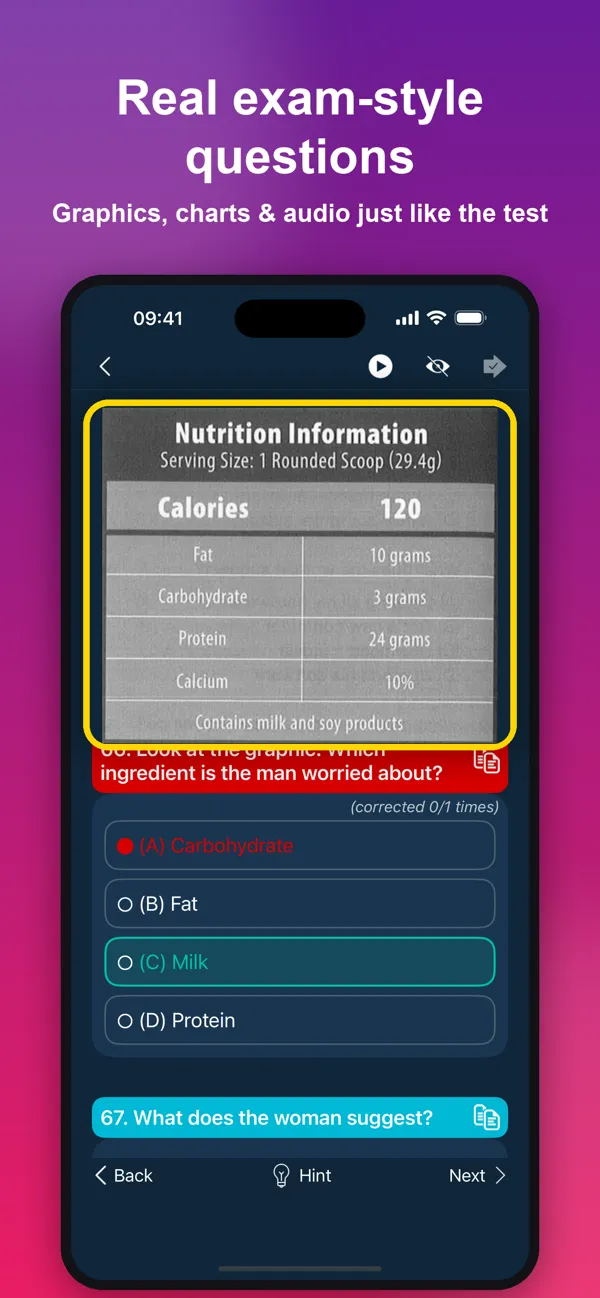
- True but not the answer: in Part 7 an option can be stated in the passage yet not answer the question asked.
- Extreme words: options with "always", "never" or "all" are rarely supported by the text.
The one rule that beats most traps
Look for the meaning, not the matching word. TOEIC writers paraphrase the correct answer ("postponed" becomes "moved to next week") and put the exact words from the audio or passage in a wrong option.
How to train
After every practice set, label each wrong answer with the trap that caught you. After a few sets you will see your personal pattern, and that is the trap to watch for on test day.
Frequently asked questions
Is the option with the same words as the audio usually wrong?
Often, yes. Correct answers are usually paraphrased, while exact repeated words are a common distractor, especially in Part 2.
How do I avoid word-form traps in Part 5?
Before reading the options' meaning, decide what the blank needs: a noun, verb, adjective or adverb. That usually leaves one option.
Why are "NOT true" questions in Part 7 tricky?
Three options are true and appear in the text. Find and eliminate them; the one you cannot find is the answer.